Truth Tables
Each individual statement can be assessed to be True (1/T) or False (0/F)
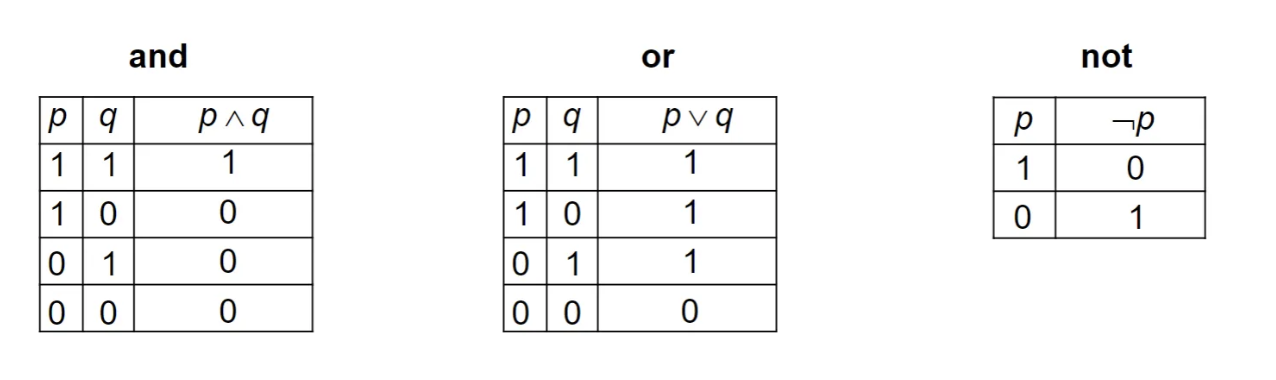
- Connective and:
- Connective or:
- Negation not:
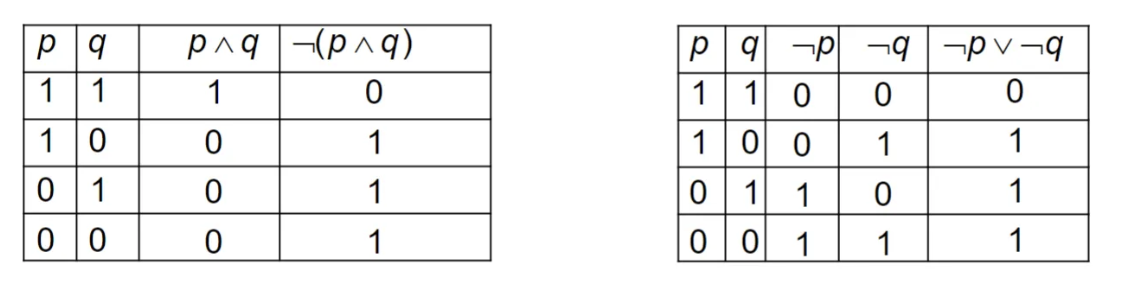 Two statements can be logically equivalent if their truth tables have identical values. For example, and are logically equivalent above.
Implies
“p implies q”, written as says “if is true, is also true”
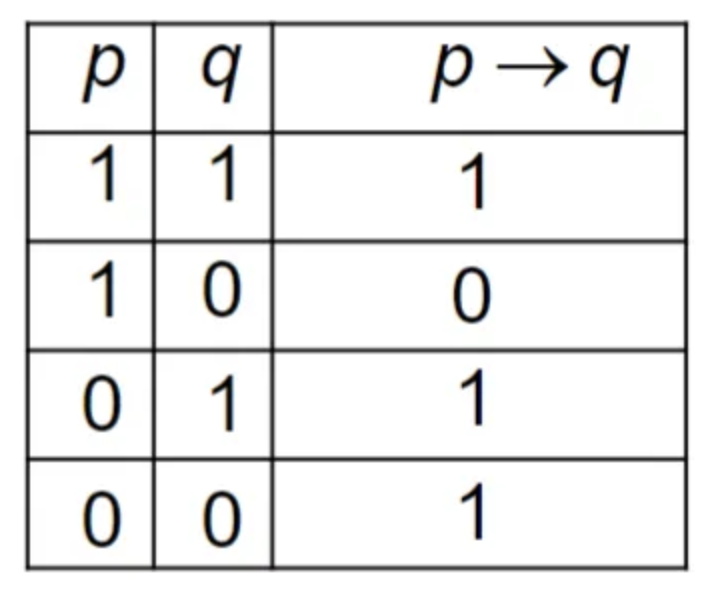
The top two rows are trivial. For the bottom rows, we have no information on . By convention, since we cannot disprove the implication (if is not true), we accept that the implication (the result of ) is true.
Loosely translated to: if the first one is true, only if the second is also, plus all the times it’s not the first one
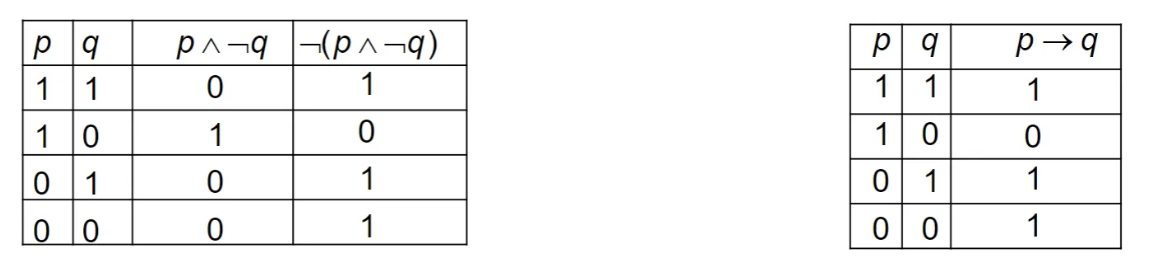 Note that is logically equivalent to , and similarly is logically equivalent with .
Tautology / Contradictions
A tautology is a statement which is always true, regardless of truth assignments. is always true (I own a pet dog or I do not own a pet dog).
A contradiction is always false, regardless of its truth assignments. is always false (I own a pet dog and I do not own a pet dog).
Variables
: where “x is an even integer” : where “x skipped breakfast this morning” (does not need to be quantitative)
Quantifiers
“For all” and “there exists”
For all
Need to define the “universe of discourse” (the set of objects which the statement is defined for).
Typically can be all real numbers (), all positive real numbers (), all integers (), etc.
For example, translates to “for every integer , there exists a value which is an integer”, which is true. is not true however, for example the case of . If we changed the universe of discourse to be (all positive real numbers), both statements would be true.
Negation of Quantified Statements
We need to find one counterexample.
Let be defined on the set of all dogs, and let be the statement “this dog has four legs”.
The statement “Every dog has four legs” would be written as .
Its negation is written as “there exists a dog which does not have four legs”, ie. . Therefore, the negation of is .
Similarly, to negate , we would have to show that for all , is not true (ie. the negation is ).